Why an eco-hamlet?
In response to today’s ecological and social challenges, citizen groups are creating new ecological, solidarity-based places: eco-hamlets, ecological co-housing, community hubs… These new places to live are inventing tomorrow’s world, and the Plessis eco-hamlet is one of these experiments. It belongs to the oasis network run by the Coopérative Oasis.
The eco-hamlet gives its residents ways to live more resiliently, soberly and autonomously through the strength of the group. Pooling, mutual help and sharing make it simpler to consume less, build less and grow part of our food, and also to organise together for greater autonomy. Ecological houses, reed-bed water treatment, dry toilets, shared buildings… all of this comes from cooperation between the members of the project.
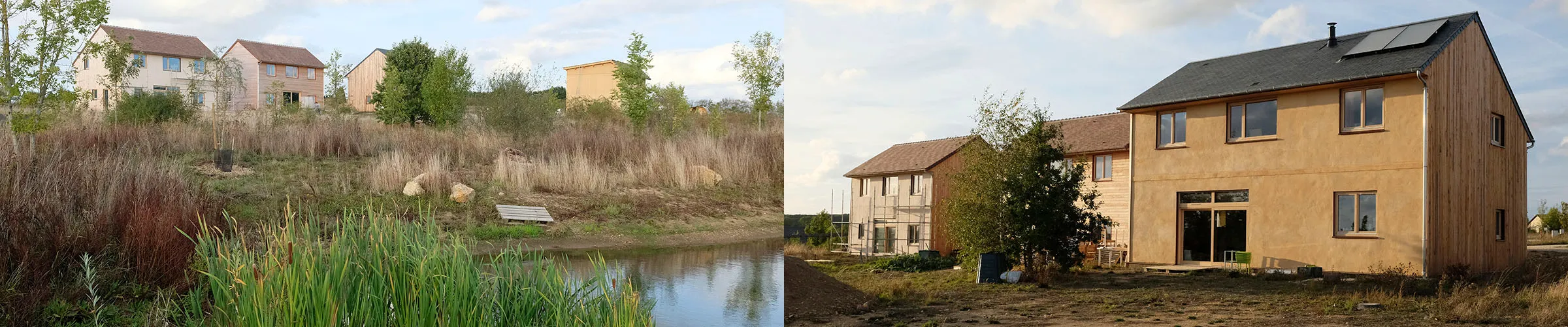
The group chose the form of an eco-hamlet, meaning a set of independent houses, because of the layout of the land and the size of the group. Collective ownership can be harder to manage at this scale. We were lucky to acquire undeveloped building land barely 200 m from the Ferme du Plessis. To keep some privacy and to limit costs, each family owns and builds its own house, but more than 4/5 of the land remains collective.
Legal and financial structure
The project is run by an association syndicale libre (ASL), a French landowners’ association, whose main role is to manage the common property. This is simpler than collective ownership structures (SCI, housing cooperatives…) and more flexible than standard co-ownership.
Each household owns a small private plot, subject to building rules that limit individual choices: mandatory dry toilets, bio-based materials, respect for local architecture, thermal requirements… This ensures high ecological quality while leaving each household responsible for the work on its house. It also allows a variety of projects (self-build or not, different building methods…).
The ASL manages the collective areas, which make up most of the land. It has its own statutes and internal rules.
Since most residents were already known when the development permit was filed, we chose not to create an intermediate structure, to avoid a double transfer of ownership and a structure with a limited lifespan. In 2017, 26 households co-signed a development permit and legally became co-developers. Each household then bought its plot directly, and the ASL set up after the permit was granted owns the rest of the land.
Download the ASL statutes (in French). Download the building rules (in French).
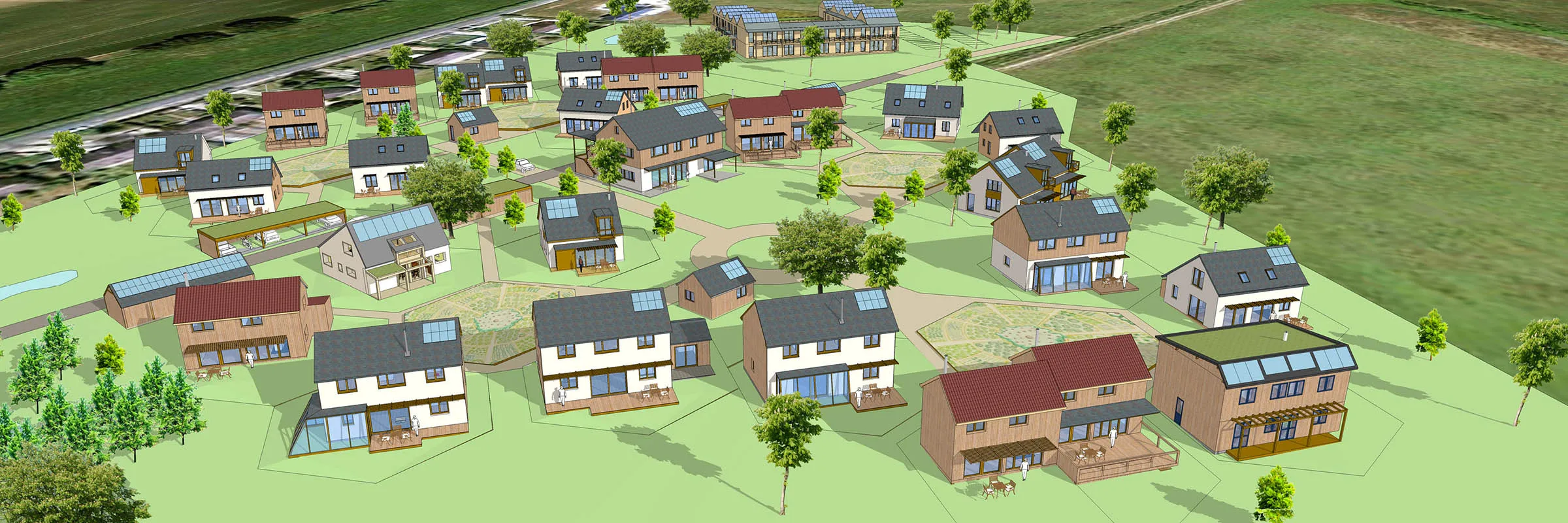 credits: atelier108architecture
The ecological dimension and the site plan
The eco-hamlet’s residents care deeply about the ecological side of the project and about autonomy, first in food, but also in energy and water.
All the houses follow building rules that require bio-based materials, near-passive performance, heating without fossil fuels, dry toilets, and solar or thermodynamic hot water… Each house finds its own way to meet these constraints, which makes the project a real laboratory for eco-construction.
The group chose ecological sanitation, with 3 reed-bed treatment systems installed with Aquatiris. Grey water is recycled and returns to the natural water cycle. This is part of an overall water design with swales, ponds and basins, because the local climate is wet in winter but very dry in summer. These features help the ecosystem get through summer heatwaves.
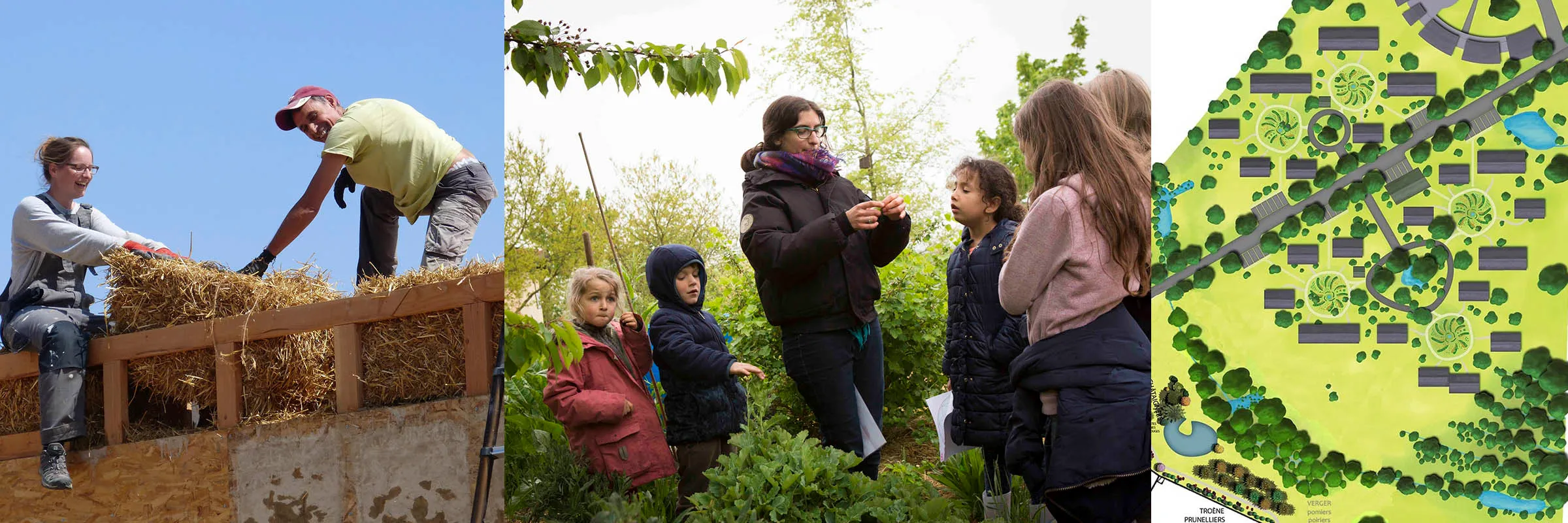
The general plan of the 4.3 hectares comes from a permaculture design that makes maintenance easier. More than 100 trees have already been planted, most of them fruit trees, along with a food forest. This design is a step towards gradually producing part of the residents’ food, with collective vegetable gardens among the houses.
Finally, sharing through common buildings reduces the residents’ ecological footprint. Shared laundries and guest rooms in the large common house mean the houses can be smaller and do without a washing machine.
Governance and how we work together
Today the ASL is run by a steering committee of 7 people elected through the “election without candidates” method. Working groups are created as needed. Major decisions remain with the plenary, so that everyone can take part.
Decisions are made by consent, following the principles of sociocracy. Many members had already practised the participatory governance in place at the Ferme du Plessis since 2011.
As families gradually move in, governance will keep evolving, handing more responsibility to working areas (common buildings, gardens…).